

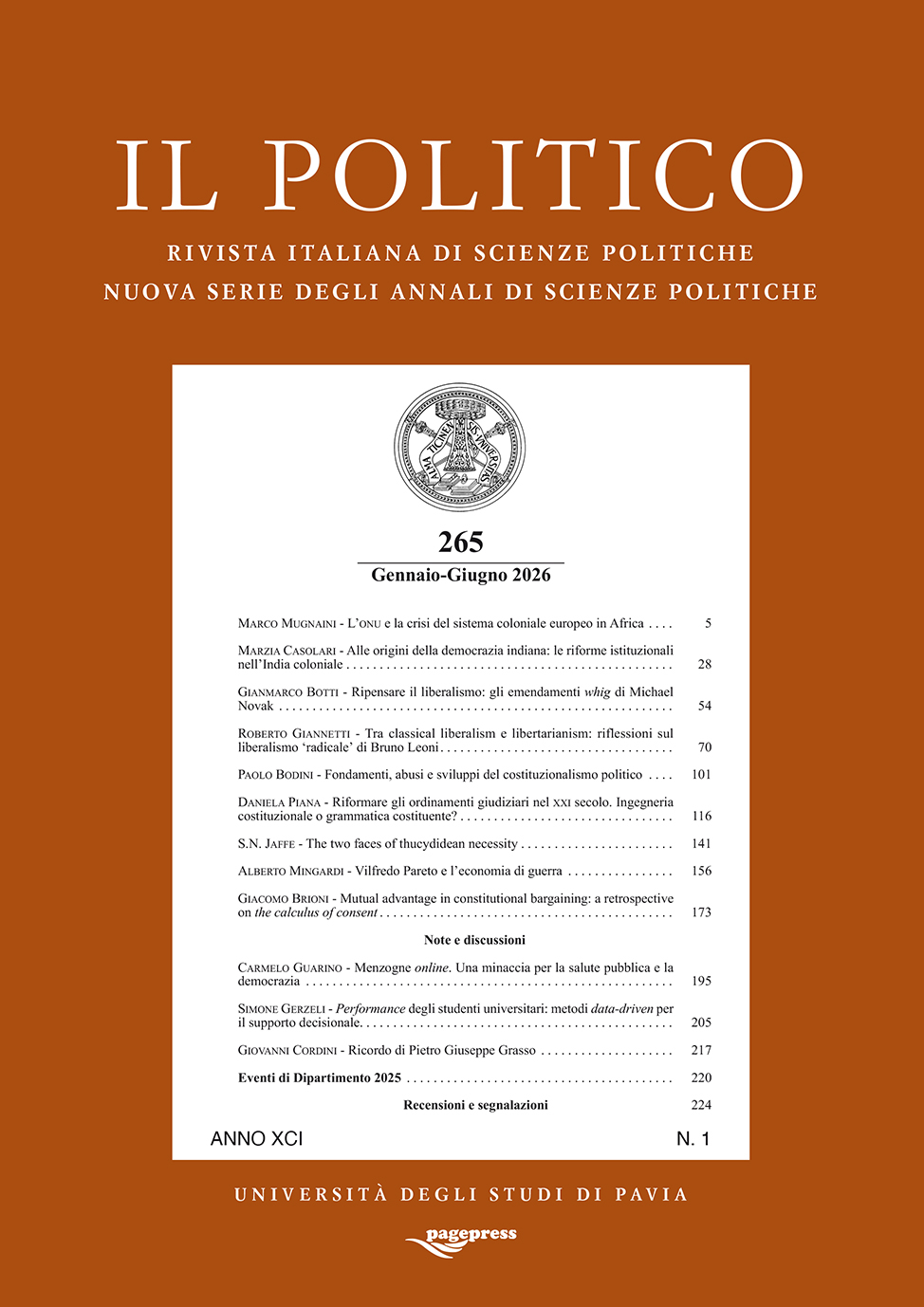

VILFREDO PARETO E L’ECONOMIA DI GUERRA
All claims expressed in this article are solely those of the authors and do not necessarily represent those of their affiliated organizations, or those of the publisher, the editors and the reviewers. Any product that may be evaluated in this article or claim that may be made by its manufacturer is not guaranteed or endorsed by the publisher.
Autori
This article examines Vilfredo Pareto’s analysis of the war economy during and after World War I, arguing that the conflict served for him as an empirical laboratory rather than a theoretical turning point. Drawing on his wartime essays, the article aims to show how Pareto interpreted the war through both his sociological and economic frameworks. Far from concluding that wartime conditions required a new economic theory, Pareto contended that the experience of state intervention, price controls, rationing, and war finance confirmed the regularities of economic science. The article reconstructs his critique of “war collectivism”. Particular attention is paid to his analysis of public debt and inflation as instruments of fiscal predation upon rentiers and small savers. Throughout, the article highlights the interplay between Pareto’s sociological theory — especially his analysis of élites, derivations, and non-logical action — and his economics, showing how the war reinforced his conviction that political actors systematically exploit pseudo-economic arguments to legitimize spoliation.
Downloads
Citations




Come citare

Questo volume è pubblicato con la licenza Creative Commons Attribuzione - Non commerciale 4.0 Internazionale.