

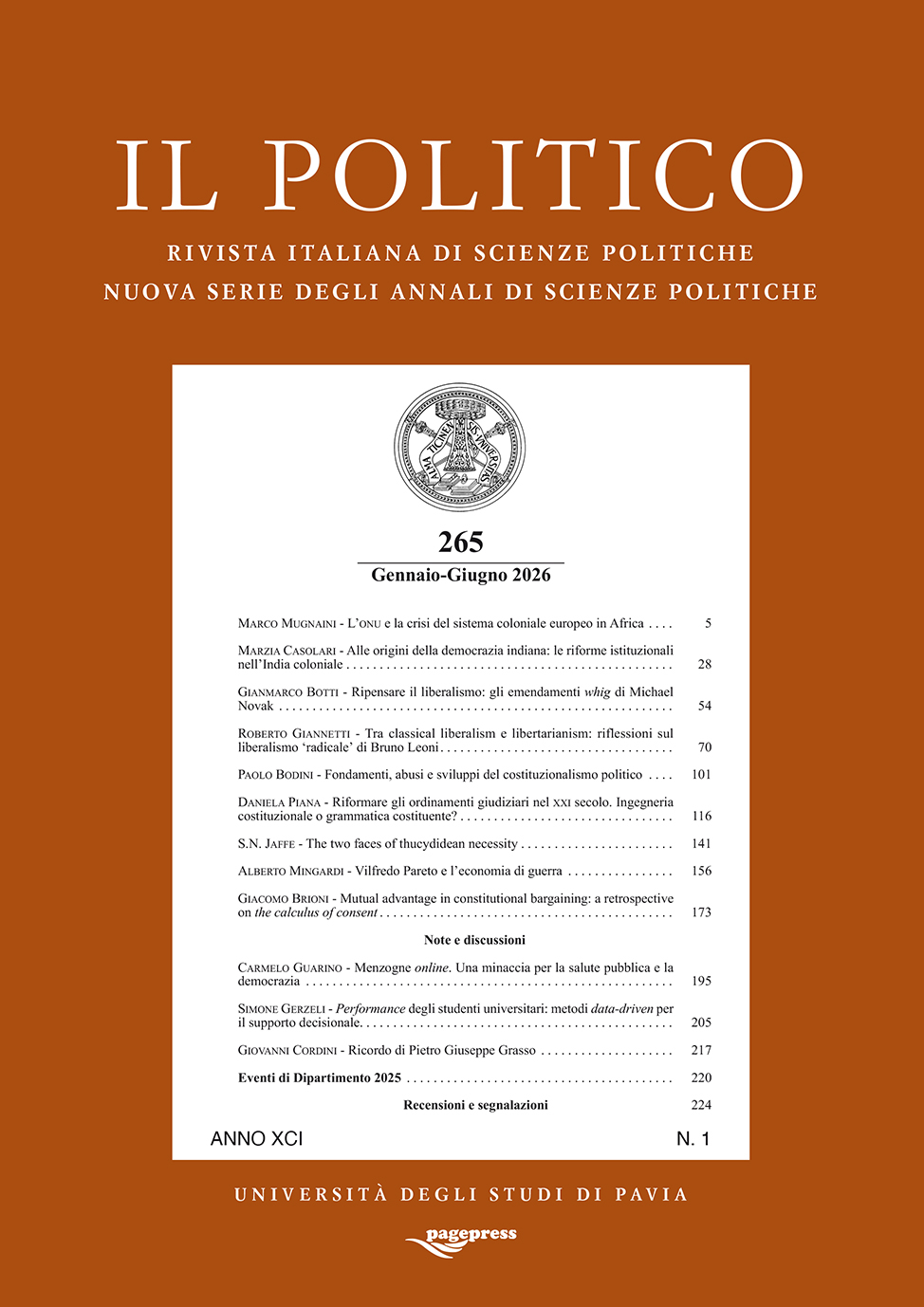

L’ONU E LA CRISI DEL SISTEMA COLONIALE EUROPEO IN AFRICA
All claims expressed in this article are solely those of the authors and do not necessarily represent those of their affiliated organizations, or those of the publisher, the editors and the reviewers. Any product that may be evaluated in this article or claim that may be made by its manufacturer is not guaranteed or endorsed by the publisher.
Authors
This paper studies the evolution of the UN’s position facing the crisis of the European colonial system in Africa. After World War II, the colonial systems had entered a phase of deep transformation; in its early years, the UN tried to regulate the colonial question, without, however, adopting a clear position against colonialism. But with the weakening of the colonial systems of Great Britain and France, especially after the Suez Crisis of 1956, the UN became the arena for the conflict between colonialism and anticolonialism. In the history of the UN, 1960 (optimistically named the “Year of Africa”) was a time of great hope, marked by the increase in membership of many States after long decades spent under the colonial rule of France, Great Britain, and Belgium. Added to this was the adoption of Resolution 1514 (XV) against colonialism. But at the same time, Africa became the real battleground of the Cold War, and the Congo was its epicenter; confirmation of these dynamics can also be found in the events concerning the ONUC mission (1960-1964) and the key figures involved (from Hammarskjöld to Lumumba). For Sub-Saharan Africa, that period marked the transition from the Eurocentric colonial phase to the neocolonial phase. With the crises of 1960–1965, the Global Cold War had reached Africa and influenced the decolonization process and the activities of the United Nations.
Downloads
Citations




How to Cite

This work is licensed under a Creative Commons Attribution-NonCommercial 4.0 International License.